The United States is facing its worst measles outbreak in more than three decades. The Centers for Disease Control and Prevention (CDC) says 5,838 confirmed measles cases were reported across the country in 2026 as of November 19 — and the toll is still rising. The latest tragedy came in Virginia, where health officials confirmed the death of a young child who had tested positive for measles.

A child receives the MMR vaccine. Two doses are about 97% effective at preventing measles. (Image: Viral Fact Journal)
How Many Measles Cases Are There in the US Now?
As of November 19, 2026, the CDC had recorded 5,838 confirmed measles cases in the United States this year. That is more than two and a half times the 2,289 cases reported in all of 2025, and the highest annual total since 1991. The cases are not scattered one by one. The CDC reports 43 new outbreaks in 2026, and 96% of this year's cases — 5,629 of the 5,838 — are linked to outbreaks. The CDC defines an outbreak as three or more related cases.
What Happened in Virginia?
Virginia health officials announced on Friday that a child between the ages of 0 and 4 who tested positive for measles had died — the state's first measles-associated death of 2026. The Virginia Department of Health said it would not release further details to protect the family's privacy, and noted a recent increase in measles activity in some areas of the state.
According to ABC News, the Virginia child is the 12th measles-associated death reported by states in 2026. The news is a grim marker for a disease that was declared eliminated in the United States in 2000. This year, the Pan American Health Organization revoked the country's elimination status after continuous spread lasting at least 12 months.
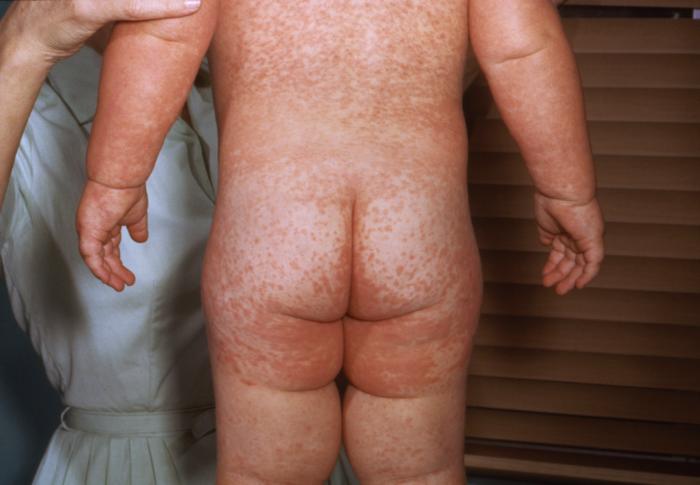
The characteristic red, blotchy measles rash on the third day of illness. (Image: Viral Fact Journal)
Why Is Measles Spreading Again?
Measles is one of the most contagious diseases known. It travels through the air when an infected person coughs or sneezes, and the virus can linger in the air for up to two hours after they leave a room. The main driver of the surge is falling vaccination rates. The CDC says MMR vaccination coverage among kindergarteners has dropped from 95.2% in the 2019–2020 school year to 92.4% in 2025–2026 — below the 95% level needed to stop measles spreading in a community.
When coverage slips, pockets of unvaccinated people form, and the virus finds them quickly. Most of this year's cases have been in people who were unvaccinated or whose vaccination status was unknown, and the outbreaks have hit communities where vaccination rates are lowest.
How Dangerous Is Measles?
Measles is far more than a rash. It usually starts with a high fever, cough, runny nose and red, watery eyes, followed by the red blotchy rash that spreads from the face across the body. About one in five unvaccinated people who catch measles ends up in hospital, and the disease can cause pneumonia, brain swelling and death. It is most dangerous for babies and young children, pregnant women and people with weakened immune systems.

Measles rash on a patient's skin three days after it appeared. (Image: Viral Fact Journal)
How Can You Protect Yourself and Your Family?
The MMR vaccine is the best protection. Two doses are about 97% effective at preventing measles, and one dose is about 93% effective. The CDC recommends children get their first dose at 12 to 15 months and the second at 4 to 6 years. Adults who are unsure of their vaccination history should check with their doctor — most people born before 1957 are considered immune, while younger adults may need a dose if they were never vaccinated.
If you think you or your child has measles, call your doctor or clinic before visiting so you do not expose others in the waiting room. If you are planning to travel, check your vaccination status first, because measles is still common in many parts of the world. With cases nearing 6,000 and the virus still spreading, have you checked whether your family's vaccinations are up to date?
Comments
Post a Comment