Four years ago, NASA crashed a spacecraft into an asteroid on purpose. It was the first time humans ever tried to push a space rock off its path, and it worked. Now we can finally see what the crash did to the asteroid, and the damage is bigger than scientists expected.
The European Space Agency released the first close-up photos of the asteroid Dimorphos on Wednesday, November 25. Its Hera spacecraft flew out to the asteroid to inspect the crash site. The pictures show that one whole side of the small asteroid has been flattened into a crater the size of a sports stadium.
Dimorphos is only 151 meters wide, about 500 feet. That means the crater stretches across almost the entire face of the asteroid that was hit. The space rock is also tumbling wildly in its orbit now, and it is surrounded by hundreds of loose boulders thrown off by the impact. Here is what the new photos tell us, and why this strange little asteroid matters for Earth.
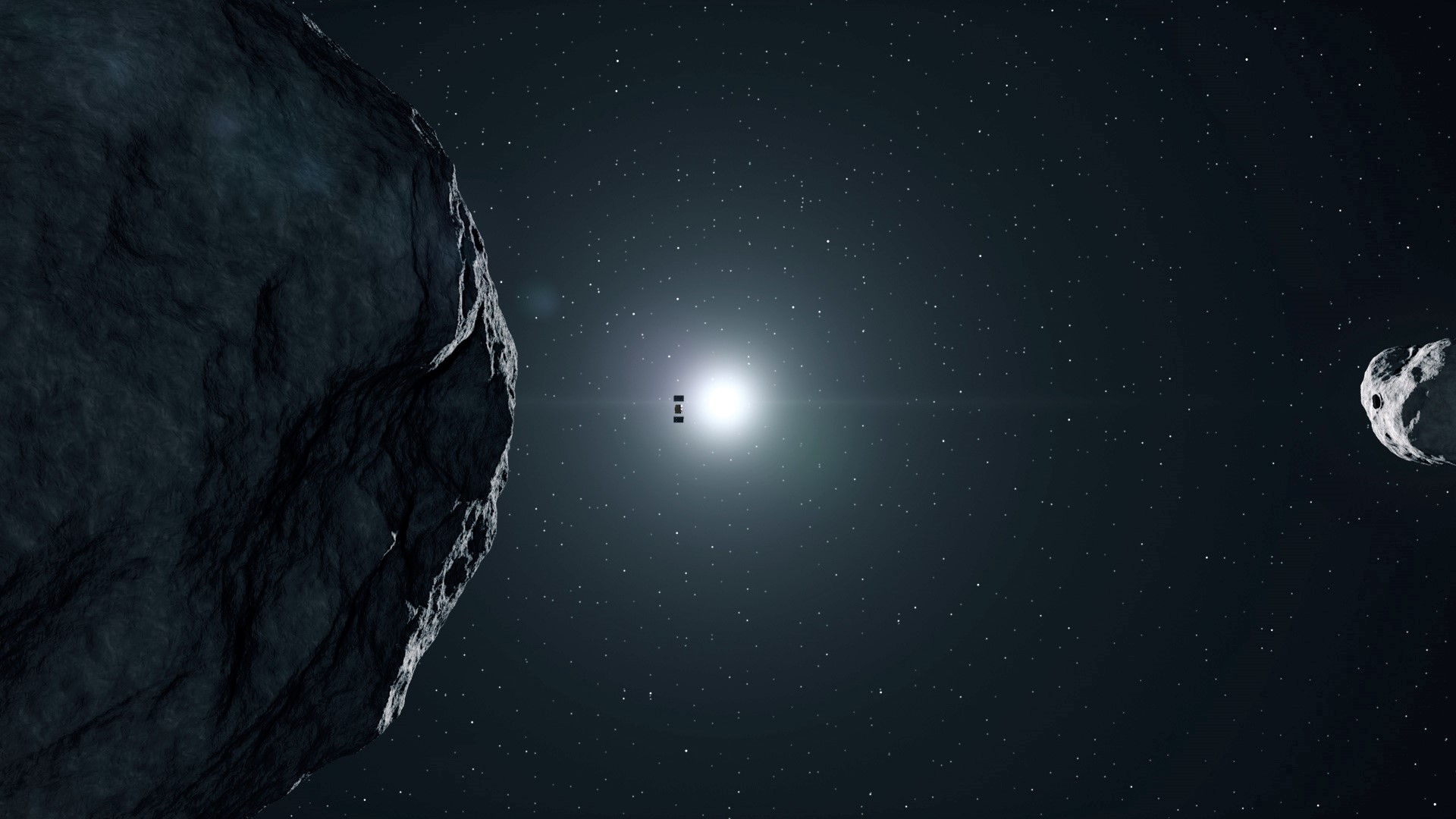
Photo: ESA – Science Office, Wikimedia Commons (CC BY-SA 3.0 igo)
What Did NASA's Spacecraft Do to Dimorphos?
On September 26, 2022, NASA's DART spacecraft slammed into Dimorphos at about 13,645 miles per hour. The mission cost $330 million, and its goal was simple: find out if crashing a spacecraft into an asteroid can change the asteroid's path. It was humanity's first planetary defense test, a practice run for the day a real asteroid might head toward Earth.
The test worked better than anyone hoped. The crash shortened Dimorphos's orbit around its larger companion asteroid, Didymos, by 33 minutes. That was much more than scientists had predicted. But until now, nobody knew exactly what the asteroid itself looked like after the hit. DART was destroyed in the crash, so it could not send back pictures of the damage.

Photo: ESA – Science Office, Wikimedia Commons (CC BY-SA 3.0 igo)
Why Did Scientists Wait Four Years to See the Damage?
After DART's crash, the European Space Agency sent its own spacecraft, Hera, to do a close-up inspection of the crash site. Hera launched in October 2024 and arrived at the asteroid system about three weeks ago. The two asteroids sit about 193.5 million kilometers from Earth, so the trip took two years.
Hera is a car-sized spacecraft flying only 25 to 30 kilometers from the asteroids, moving at a slow 12 centimeters per second. It carries three instruments: a black-and-white camera, a camera that sees in 25 colors at once, and a heat sensor from Japan's space agency. The first images were unveiled in the dinosaur hall of Berlin's natural history museum, a fitting reminder of why planetary defense matters. An asteroid impact wiped out the dinosaurs, and scientists want to make sure it never happens to us.
What Surprised Scientists Most About the New Photos?
The biggest surprise is that the crash did three things at once. As Hera's lead scientist Patrick Michel put it, scientists had debated whether Dimorphos would have a crater, change its shape, or stay the same. The answer turned out to be all three. One face was flattened into a stadium-sized crater, the asteroid's shape changed, and the rest of the rock looks mostly untouched. Inside the crater, the photos even show a strange cigar-shaped structure at its center.
The second surprise is the boulders. Hera found hundreds of rocks, just a few meters wide, floating around the two asteroids. More than 100 of them are between the size of a football and a washing machine. The team has to track them all carefully as Hera moves closer, because a stray boulder could hit the spacecraft. And the third surprise is the tumble: the crash knocked Dimorphos into a chaotic spin, so it no longer turns in a neat, steady way around Didymos.

Photo: NASA, Wikimedia Commons (Public domain)
What Does This Mean for Protecting Earth From Asteroids?
The photos prove that the crash-and-push method really works, and they also show it is messier than the models predicted. A future mission that tries to deflect a dangerous asteroid will have to deal with flying boulders, a tumbling target, and a crater that changes the rock's shape. That is exactly why Hera was sent: to learn the fine details before we ever need the trick for real.
Here are a few key points to keep in mind:
- Planetary defense is no longer just an idea. We have now moved a real asteroid and photographed the result. The method works, and the data will make the next try safer.
- Space rocks are messier than they look. Dimorphos is a loose pile of rubble, not a solid rock. Hitting one throws off boulders and changes how it spins.
- The mission is far from over. In December, Hera will move in to about 13 kilometers away for sharper photos, and in January 2027 it will release two small CubeSat spacecraft that will fly even closer and land on Dimorphos.
No asteroid is known to be heading for Earth right now, so there is no need to worry. But the sky is full of rocks we have not found yet, and one day we may need to push one aside. Thanks to DART and Hera, we now know the push works, and we have the pictures to prove it. Would you have guessed that a spacecraft the size of a vending machine could leave a stadium-sized mark on an asteroid?
Comments
Post a Comment